
"You Are Our Sister, O": Two Visits to a Nigerian Braiding Shop in Atlanta
I think often about oral tradition and how it still powers the Black community. Community enclaves like hair salons are communication hubs where information is shared and culture is stewarded. The thing is, you need a signal or a lead, if you will, to find the right salon.
I’ve been in Atlanta for about two months. I was chatting with a close friend who has been in Atlanta for two years, and at some point, I mentioned needing my hair braided. “I have a place,” she told me, “and it’s great—they do wonderful work— but it’s not like the salon we’re used to going to.”
Intrigued, I asked for the name of the shop. “Braids by Chi,” she shared.
Almost every Black person in the US can trace their roots to West Africa, and the digital age has helped us connect with and understand the diaspora more than ever. My perpetual curiosity about where we’ve come from has led me to beautifully authentic African literature, music, and cinema. From this, I’ve grown to understand the evolution of West African nomenclature and how it often involves the truncation of traditional names for easier pronunciation and other reasons.
When looking at Igbo naming customs, Ifeoma becomes Ife.
Uchechi becomes Uche.
Oluchi becomes Olu.
And Chioma becomes Chi.
This was an African braiding shop.
I had never been to one before, but because of social media, I’m acutely aware of the ways in which American Black women sometimes broadly describe them.
Stringent customer service. Fast braiding. Incredibly tight to the scalp.
Often unfazed by the court of public opinion, I was now even more curious.
I texted Chi introducing myself, letting her know where my referral had come from, and sharing a picture of the style I wanted. Blonde cornrows all the way down my back.
She patiently answered all my questions and before I knew it, the day of my appointment had arrived.
I parked in front of the plaza where the shop sat squarely in the middle. The lights were off, presumably to keep the shop cool on what shaped up to be one of the hottest days in Atlanta.
“Hi, I’m Kay!” I said brightly to two women and a young girl, one in the first right chair, the second on a leather futon toward the back of the shop, and the last standing—all gazing down, seemingly uninterested, at cell phones.
“How can we help you?” Chi questioned.
“I’m the one that texted about the blonde cornrows.”
“Sit there,” she motioned toward the first left chair. She sauntered to a locked room in the back of the shop, passing a white refrigerator with cereal stacked atop and a sink in the back left corner.
I took this time to really scan the shop. At 11:00a.m. I was the only customer so far. Aside from the black futon, refrigerator, and sink, there were several vanities lining each side of the shop, each equipped with a mirror and not much else, save a blow dryer, stray braiding hair, and the largest jars of vaseline and hair gel I had ever seen. There were African sconces between each mirror and a handful of wood carved trinkets on a counter overflowing with papers to my left.
When Chi returns, she carries several packs of blonde prestretched kanekalon hair. Numbers 27 and 30. Confirming it was the color I wanted, she opens each pack and begins quietly layering strands of each color across a small black TV table. When all of the hair was layered, she lifts it collectively into the hair with one hand and combs it through with the other hand to reveal a beautiful custom color mix. I had never seen it done this way. I was fascinated.
Besides the Nollywood film that they intermittently laugh hysterically at, the shop was mostly silent.
Chi grabs a stool, positions it behind me, and sits to begin parting my hair. Soon after, the other woman joins her. She grabs a stool of her own, begins quietly sectioning the braiding hair, and passing thin sections to Chi. Finally, the young girl who I learned was Chi’s daughter, joins the party and suddenly it’s a six-hand operation. As Chi parts my hair and starts each braid, her daughter finishes each one.
I’ve been getting braids my entire life, but I’m curious about it as as a practice, so I Google to find that braiding is one of the oldest hairstyling practices in the world, tracing back roughly 5000 years, with some hair braiding experts pointing to the Himba people of Namibia as an early origin point. Archaeological evidence points to one of the earliest styles being—you guessed it—cornrows, the style I was getting.
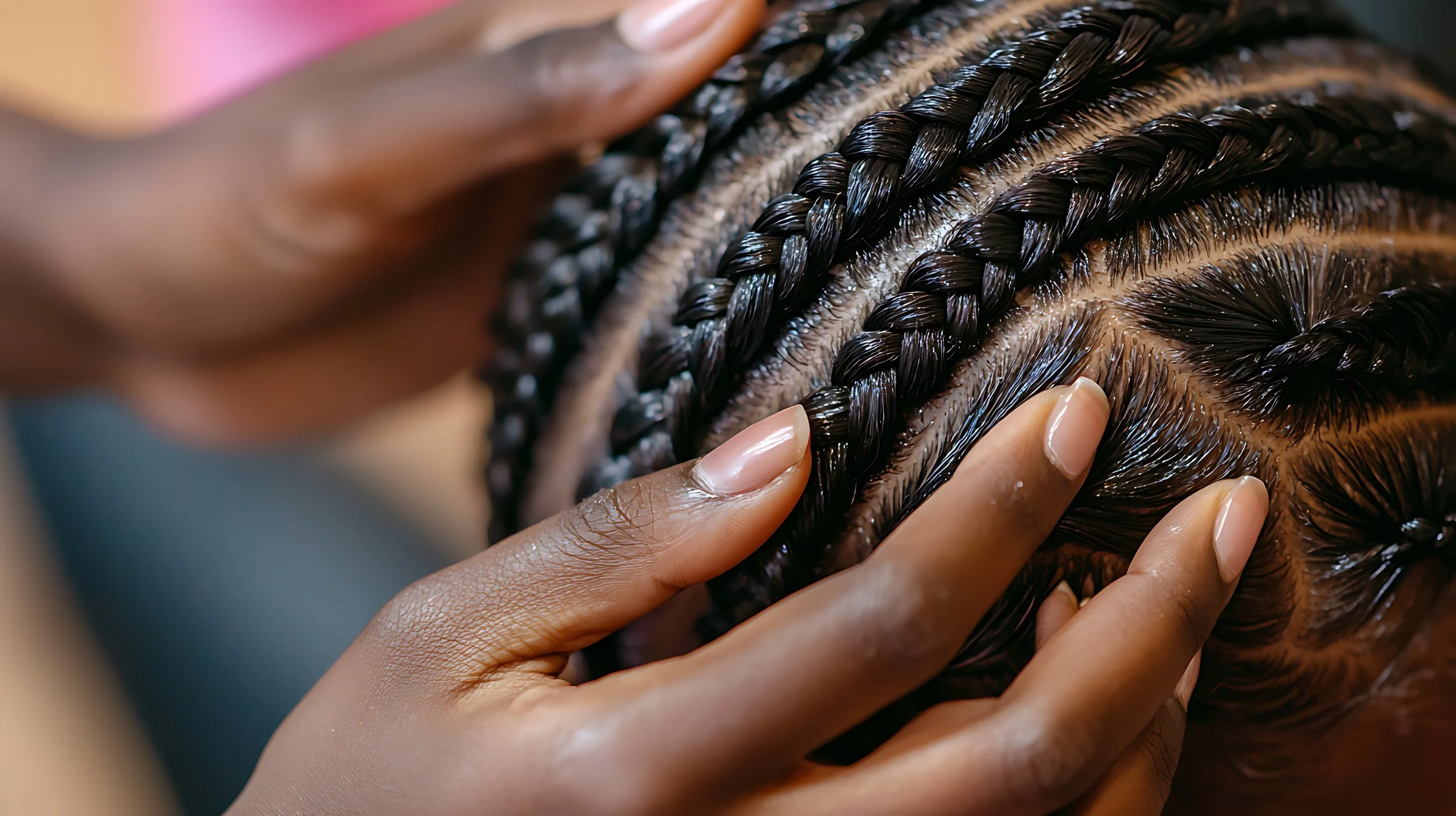
All of these years later, I don braiding styles because not only do I feel my best in them, but I feel particularly connected to my roots when I wear them. As the three women with fast moving fingers move across my head, I close my eyes and imagine what it must be like to have this experience in the motherland.
Most modern Black American beauty experiences are now relegated to smaller suites, often with just one person servicing clients, and until I sat in this Atlanta-based West African shop I didn’t realize how much I missed the communal experience of the traditional salon. I also could not have imagined it would have made me ache for a home I never knew in Nigeria.
Nearly an hour into my appointment, another customer enters the shop. Her voice is booming and her words are colorful. I can tell she’s a regular. Her hair is already braided boho style, but I learn that she’s here for a refresh and is pressed for time, but she is adamant that they save the human hair that had already been woven into her current style.
Both Chi’s daughter and the woman who had been handing Chi sections of braiding hair jump ship to begin carefully removing her human hair, leaving just two hands working quickly across my head.
It was at this moment that Chi spoke directly to me for the first time since she had confirmed I liked the custom mix of color she had concocted. “I braid fast, you don’t need to worry,” with a reassuring smile.
Sure enough, even with more than one customer, my cornrows were complete soon after.
I rose from my chair feeling the light breeze of a low humming air conditioner on my scalp, but not before white foaming mousse was piled onto my hair, gently rubbed downward, and then a generous cloud of olive oil sheen surrounded my head. I stepped anxiously into the mirror, the upgraded version of the woman who had entered the shop with wild hair just two hours before.
“It’s beautiful,” I turned my head side to side, watching the light catch the new color. The natural black of my hair effortlessly ombres into number 30 and then number 27.
I thank Chi and confirm that my Zelle payment of $180 + $20 tip has come through before exiting the shop, certain that I had found a new home for my hair in Atlanta.
About a month later, I reached out to Chi again. Assuming she doesn’t remember me, I text:
“Hi there, my name is Kayla. I came in a couple months ago to get my hair done and loved it. I was wondering if you had any availability this Friday to do knotless box braids? I know it’s very last minute so I understand if not.”
A minute later, the message, “Yes what time do you want to come,” flashes in a blue bubble across my screen.
On Friday morning, I arrived at the shop promptly at 10:00 a.m.
Chi smiles at me, showing all 32 teeth, and asks how I’ve been. In my mind, her smile meant I had been initiated. Immediately, she is warmer and considerably more talkative.
She motions for me to sit down in the same chair as I did last, while asking how I liked the cornrow style I had and how long it lasted. “Almost four weeks,” I share, as I gush about how much I loved it and how many compliments I had gotten.
This time, the same woman is there, but her daughter is not. I assume she has returned to school—I later learn that I’m right. The woman ambles over, this time wearing a different hairstyle herself, and begins finishing each of the box braids that Chi begins in rows across my head, bottom to top, right to left.
The television is not on this time and the air conditioner blows more intensely. Simultaneously Chi and the other woman accept phone calls. Perhaps in another setting, this may have overstimulated me, but for the moment I’m engrossed.
I can decipher the nature of each conversation by the differing tones and English interspersed into each. Chi amusedly discusses a woman expecting whose husband has just purchased a cybertruck instead of items necessary for the babies arrival, while the other woman arranges for furniture and home decor items purchased in the US to be placed in a newly purchased truck, preferably a 2010-2012 Toyota, and the truck placed in a shipping container to be sent back to Lagos.
“He has not begun preparing for the arrival of his own child? Jesus!”
“If the repairs to the truck are not sensitive, purchase it and it can be fixed in Lagos.”
“There are many items you will need for a baby. Are you not concerned, o!”
“These items will go to the house in the village. Are you certain you understand?”
Now, I’m doubly captivated by the use of language as they flow in and out of Igbo and English, often using words I don’t understand at all and other times using phrases that I don’t hear so often in casual American conversation like “inasmuch as.”
After the parameters had been set for finding a truck to ship back to Lagos and Chi had her fill of gossip, the shop was silent once again.
This was my opportunity. Her earlier warmth had given me courage to ask the handful of burning questions I had.
“Chi, are you Nigerian?”
“Yes, Igbo. From the Eastern part of the country.”
“And did you learn to braid there?” I wonder.
“Yes, we are very known for our braids there. Have you been to Nigeria?” Now returning a question.
“Not yet, but it’s on my list. I recently went to Africa for the first time, Kenya, to be specific, but I have so many other places I’d like to visit there. I’ve just done my ancestry not long ago, and Nigeria was most prominent in my featured regions.”
27%, in fact.
“Eh Eh! You are our sister and you are hanging in the shop with us today, o!”
I flash a smile, knowing for certain now that I have been accepted.
“You must move Nigeria to the top of your list! It is a beautiful country and we are known for our food and dancing,” she proudly shared.
Almost on cue, a younger woman enters the shop with a larger-than-life personality. She teases Chi and the other woman in Igbo, and they roar with laughter. When she next makes a joke, it’s in English and I laugh along. The woman braiding my hair is tickled at my laughter, and I take advantage of this opening.
“What is your name?” I ask her.
“My American name is Grace, but my Nigerian name is Ezinne.”
“Ezinne,” I repeated.
“Eh! You got it now!” She exclaimed.
The younger woman’s name is Mfechi, or just Rachel, and I learn that she is selling food. At this moment, I became conscious of the similarities between Black American beauty shops and West African shops.
Growing up, my grandmother owned a hair salon, and characters much like Mfechi would flow in and out of the shop. They were always usually close friends or relatives of my grandmother who would show up to stir a little trouble and offer a lot of care. They’d make sure she had eaten while simultaneously trading jokes and bringing the sound of laughter to a shop that otherwise may only sound like light but pleasant conversation and television background noise. These are some of my favorite and most vivid childhood memories, as I faithfully got my hair done every six weeks.
In recent decades, immigrants from Africa brought custom braiding and hairstyling traditions into barbershops and beauty salons that were already mainstays in African American neighborhoods, or bringing an entrepreneurial mindset with them, many opened their own shops.
Across the US, women from countries like Nigeria, Senegal, Ivory Coast and Togo have used braiding as a bridge to a better life. Similarly, my grandmother owning her own beauty salon was my earliest example of an enterprising Black woman, and now, as I sat in Chi’s shop, I drew clear parallels in my mind between her shop and the shop of my childhood.
Before long, Chi, Ezinne, Mfechi, and I are all in conversation, along with another customer who has entered the chat and a saleswoman who ended up in the shop the entire length of my appointment, seven hours to be exact.
The other customer and I tune in as Mfechi shares the meals she has available for the day. Egusi and fufu. Bitter leaf soup. Jollof rice.
“How much?” The other customer and I ask simultaneously.
“You want to buy, o?!” Mfechi exclaims. “Just twenty dollars!”
She exits the shop, heading to the cooler in the trunk of her car. When she returns, the aromatic smell of Nigerian food enters ahead of her. Three white styrofoam trays are stacked in her hands, the fufu in a clear plastic bag on top in its signature smooth, round ball. She hands one tray to the other customer, one to me and then announces to the shop that she has brought a free meal for Chi as the shop owner.
“Most American people only know egusi and fufu,” Mfechi begins. “But Nigeria has nearly 1000 villages, each with their own unique cuisine. I have brought here for Chi, a dish called abacha.”
I watch in the mirror as she opens the remaining tray in her hand and a spicy scent wafts toward me. Mfechi hands the tray to Chi along with a fork. She scoops a bite of the food and murmurs, “Jesus Christ!”
We all watch in amusement before the unexpected happens.
“Would you like to taste?” Chi’s eyes roam the room to each person. Jumping to action, Mfechi flits around the room with forks for each person, Chi circling around not far behind her.
As she makes her way to me, the other customer behind me takes a mouthful, pauses, and mutters a stunned, "Oh my god."
At this point, I’m salivating. I’ve not eaten all day except a stick of gum, if that even counts.
Chi leans over in front of me with the tray, revealing tilapia, shredded, dried cassava flakes, onions and spices on top of a bed of jollof rice. I attempt to gather a forkful, but with the items in my lap, I’m struggling to gather a taste of everything in the tray. In another turn of events, Chi gently takes my fork, piles the food onto it and feeds it to me.
Immediately overcome with flavor and spices, I don’t have the time to mull over the tenderness I just experienced from a woman I’ve only met twice. It wasn’t until I returned home that I considered the gentle intimacy of the moment, perhaps because it made me think of my own mother who has now passed on.
“I am going to call my husband and tell him you are trying to fatten me up,” Ezinne says as Mfechi stands at the door preparing to leave the shop.
As her comedic encore, Mfechi says, “You do not need to call your husband because your husband is broke,” leaving the shop in a ripple of laughter.
Eventually, I can see what’s left of my natural hair peaking out has shrunk in size and is now a small puff at the middle front of my head, a signal that we are nearing the end of my appointment.
“You are going to be so beautiful, because it is already giving,” Chi tells me.
I smile modestly, because I’ve seen enough to believe in the quality of her work but also in the earnestness of her words.
Another customer enters the shop as she finishes my hair, making her way to the back of the shop to begin a pot of hot water for dipping my braids. I hear the water begin to bubble as Chi asks the latest customer about the style she wants. In just a few minutes, Ezinne grabs the heated water and begins the final phase.
“Tilt your head back, please.”
I close my eyes and lean back, joyfully considering the last seven hours I’ve spent with these women but relieved to be nearing the end of my appointment.
“You are all done, my friend!” Chi beams. She is two chairs away from me, holding a broom and dustpan in her hands.
As I rise to step into the mirror, the braids skirt the top my butt. I laugh to myself thinking of how I had asked for mid-back braids at the start of the appointment. My preferences probably never truly made a difference. In two appointments, it had become abundantly clear that Chi was going to do exactly what she wanted, not unlike me, and I wasn’t mad at her for it. In fact, I was delighted.
“See you next time,” I say, “because there will be a next time!”
“Enjoy your weekend, gorgeous!” I hear Chi’s voice as the door swings closed behind me.
Atlanta is one of the metro areas with the largest African immigrant populations in the US, but the composition of Atlanta's African diaspora is different from what you'd find in other cities.
In D.C., Ethiopians are the largest group, followed by Nigerians and Ghanaians, while in Atlanta, it's Nigerians, followed by Ethiopians and Ghanaians.
African braiding shops in the North US are more closely associated with Francophone West African communities: Senegalese, Guinean, Malian, Ivorian. This is an important distinction, as African people are not monolithic and therefore do not render the same exact braiding experience across the board.
After two appointments at what I now know to be a Nigerian shop, I find myself eager to visit those of other communities, shaping my curiosity around the difference—and similarities—I might find between them.
As a Black American woman who quite literally grew up in the salon, I have always known it as an extraordinary and sacred place, even as a child. What I could not have fully understood then that I do now is that the sacred nature of the salon is ancestral. It is a connective tissue that unifies the diaspora. It’s the vehicle that transports us along clay roads to a local village where the fingers of six hands dance in a rhythmic, familiar weave, crossing section over section without pause to deliver regal crowns of braids. It is the home we know here and the one we long for oceans away.
Note: The names of the shop and the women who work there have been changed to protect their privacy.
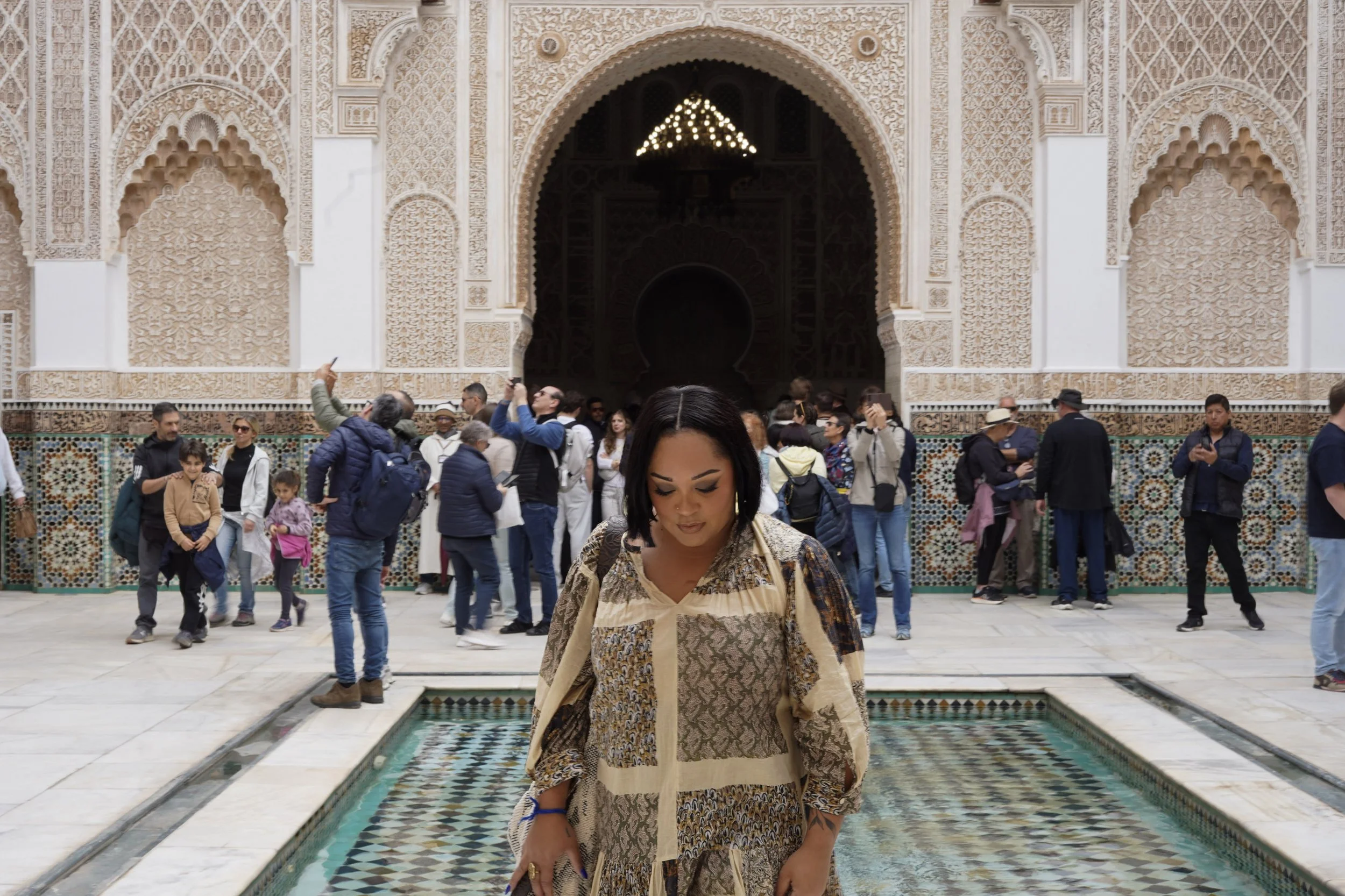
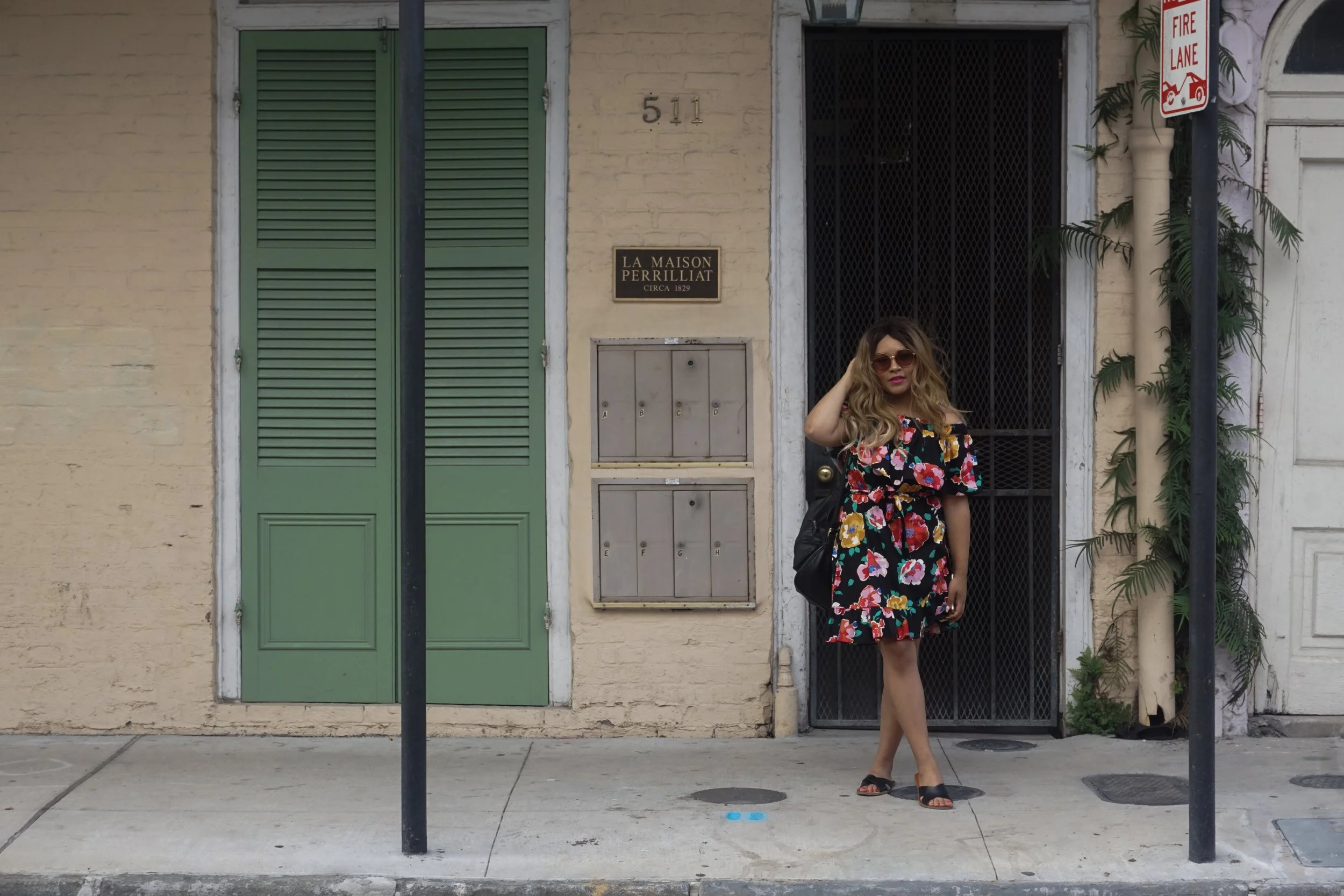
"You are our sister, o." That's what a woman I'd known for exactly two visits said to me, mid-braid, after I mentioned my DNA results. This is a story about a Nigerian braiding shop in Atlanta, six hands moving through my hair, and a home I didn't know I was homesick for.